Your best key for a song is the one that puts the melody's highest note a little below the top of your comfortable range, and its lowest note at or above the bottom of it. To find it: work out your comfortable range, work out the song's, and move the song until one fits inside the other. Then sing it in that key and in one key either side, with the band or a backing track, and keep the one that feels strong at the end of a long night, not only fresh at the start of one.
How do you find your vocal range?
You need two notes: the lowest and the highest you can sing well, with a full sound, not just reach. Use a piano, a keyboard or a keyboard app, or a tuner app that shows the note you sing.
- Warm up for a few minutes.
- Sing a comfortable note in the middle of your voice on "ah". Find it on the keyboard.
- Sing down the white keys one at a time until the sound gets breathy, weak or drops in volume. The last good note is your comfortable bottom.
- Go back to the middle and sing up until it starts to strain or squeeze. The last good note is your comfortable top.
- Write both down, and do it again on another day. Your range in the morning is not your range after two sets.
Notes are named with an octave number: middle C is C4, the C below it C3, the one above it C5.
The names of the voice types (soprano, mezzo-soprano, alto, tenor, baritone, bass) help you find your bearings, but for choosing a key they matter less than your two notes. A voice can sit between two types, and two tenors can have very different tops.
How do you find the range of a song?
Look for the lowest and the highest notes of the melody: on a lead sheet they are easy to see; otherwise sing or play the melody and find its extremes on a keyboard. Note three things:
- The span, from lowest to highest: an octave, a tenth, an octave and a half.
- Where the high notes are: one quick note in passing, or a long note at the top of the chorus. A held high note needs more room than a passing one.
- Where the melody lives: where most of it sits, which singers call the tessitura. Two songs with the same lowest and highest notes can feel completely different if one hovers near the top. A verse that sits low and a chorus that sits high pull the key in different directions.
How do you work out the right key?
Line up the song's top note with a note one or two half steps below your comfortable top, then check the bottom.
Here is a worked example. A song written in G has a melody from B3 up to E5, with the high E held at the end of the chorus. Your comfortable range is G3 to D5. In G, the top note is a whole step above your best top: too high. The candidates:
| Key | Change | Lowest note | Highest note | Verdict |
|---|---|---|---|---|
| G | as written | B3 | E5 | top too high |
| F | down 2 half steps | A3 | D5 | top at your limit, hard to hold |
| E | down 3 | G♯3 | C♯5 | room at both ends |
| E♭ | down 4 | G3 | C5 | top easy, bottom at your floor |
| D | down 5 | F♯3 | B4 | bottom below your range |
E is the key to try first, with E♭ and F as the two to compare it with. Moving the chords is the easy part: How to transpose chords into any key shows how.
If the song's span is wider than your range, no key fits both ends. Decide which end matters more: usually the chorus's high notes, since that is where the song is meant to lift. A low verse line can be sung softly, close to the mic, or moved up an octave in places.
Do lower keys always feel easier?
No. A key too low loses energy: the voice sits in its quiet, dark part and has nothing left for the chorus. The right key should make the peak of the song feel like effort, not strain. Too low costs energy, too high costs control; which hurts more depends on the voice and the song. Your own voice decides; test it.
The key also changes the colour. The same song a 4th lower can sound more intimate, a 2nd higher more urgent. That is a musical choice as much as a vocal one.
What key should a man sing a woman's song in (and vice versa)?
Start from the same key an octave down (or up, for a woman singing a man's song). If the low notes disappear a full octave down, go up a 4th from there: an octave down and a 4th up is the same as a 5th below the original. If that is still low, try a 4th below the original. The other way round, for a woman: an octave up, or a 5th or a 4th above the original. These are starting points only. Then use the method above.
What are the signs that a key is wrong?
- Your voice flips or cracks on the top note, or only gets there when you are fresh.
- You push or shout to reach the chorus instead of singing it.
- The low notes disappear under the band, however close you get to the mic.
- You are hoarse after one run-through.
- The song sounds tame: everything is comfortable and nothing lifts.
Cracks, pushing and hoarseness mean the key is too high; low notes lost under the band, or a song that never lifts, mean it is too low.
How do you test a key before the gig?
- Sing it with the chords, not alone. Over the band, a backing track or a pianist; the right key alone in your room can feel different over drums. Practicing with backing tracks is a good way to compare keys before rehearsal.
- Test at gig volume. Quiet singing hides strain.
- Test it tired. Run it at the end of a rehearsal. The key that works then is the one to keep.
- Record each candidate. It is often obvious on playback which one sounds like you.
- Ask the band. A key with five sharps is harder for some players; guitarists can often solve it with a capo, as the capo chart shows, while a trumpet or a sax reads the song in its own key, which may have more sharps still.
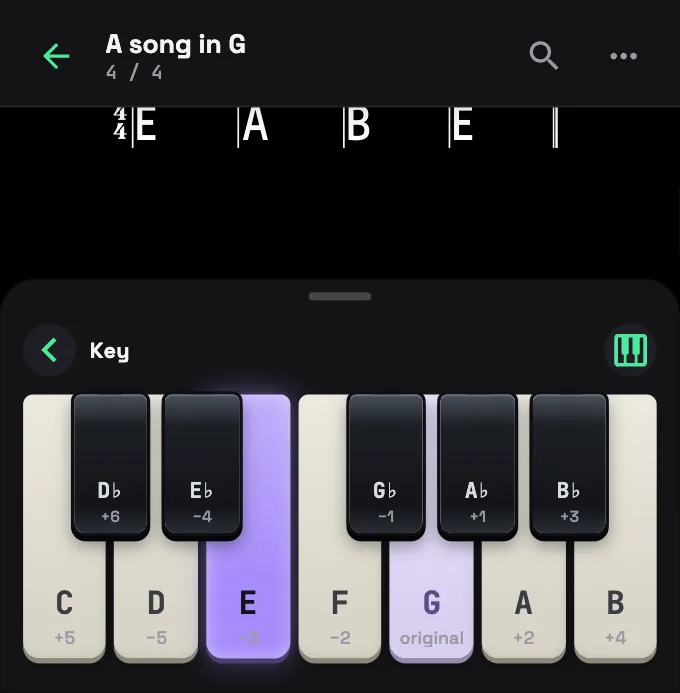
In Gigplay you can try a song in each candidate key in seconds: the Key pad moves the chords and the melody, and the Player's band plays along in the key you chose (see Changing key). The key is remembered for that playlist, so your set can keep the song in E while the band's practice list keeps it in G.
How do you keep track of your keys?
Write the key you chose next to every song in your setlist and on your charts, and tell the band before rehearsal, not at it. If you play with an accompanist, agree on how keys and starting notes are called; Accompanying a singer covers that conversation. And when two songs in a row sit in very different keys, plan how you move between them: Segues between songs in different keys has ways to do it.