

To practice with a backing track, and not just play along to it, decide what you're working on before you press play. Set the track up for that one thing (tempo, key, which instruments, which bars or measures), give every time through the form its own task, and record the last chorus so you can hear what happened. A track that runs while you noodle is pleasant, but it teaches you very little: you play what you already know, and it sounds fine because the band covers for you.
Why does playing along turn into noodling?
Because a backing track never stops. Nobody looks at you when you get lost in the eleventh bar; the bass carries on, and two bars later you've found your way back without noticing you were gone. And because it's comfortable: it's easy to reach for a tempo and a key you already play well, and run our favourite phrases over them.
That isn't wasted time, but it's playing, not practice. Practice is the part where you work on something you can't do yet, and a backing track only helps with that if you make it ask something of you.
Which jazz backing tracks should I practice with?
There are hours of jazz backing tracks to be found, and the best one is the one that fits what you're working on. A starting point, with tempos in beats per minute (BPM):
| You're working on | Pick | Tempo |
|---|---|---|
| Your first tune over changes | A blues in F or B♭, medium swing | 100–120 BPM |
| Slow playing, long notes, space | A ballad, 32 bars | About 60 BPM |
| Three in a bar | A jazz waltz | 120–160 BPM |
| Straight eighths, a lighter touch | A bossa nova | 120–140 BPM |
| The minor ii–V–i | A loop of Em7♭5, A7, Dm7 (D minor), two bars each | Start at 80 BPM |
| Keeping up at speed | A medium-up swing on a tune you know well | 180 BPM and up |
Whatever the track, check that it has the right form, a count-in and enough choruses, and the style you'll play the tune in. Then, for practice, two things matter most: a tempo and key you can change without the sound going strange, and instruments you can turn off one by one.
A recording of a real band is lovely to play with, but it's fixed: one key, one tempo, one arrangement. A generated track can be changed to fit the task; play-along apps covers what to look for in one. Use both. To get any of the tracks above in any key, built from your own chart, see how to make a backing track.
How should a backing track session be laid out?
Here is a plan for 30 minutes on one tune or progression, say a blues in F with jazz changes (how jazz reworks the 12-bar):
| Minutes | What the track plays | What you do |
|---|---|---|
| 0–5 | The whole form, at tempo | Follow the chart. Count the bars, say each chord as it goes by, hear where the form starts again. |
| 5–15 | Two to four hard bars, looped, slower | Work on the one problem: the minor ii–V, the quick change, the line that won't come. |
| 15–25 | The whole form, a little under tempo | One task per chorus (see the next table). |
| 25–30 | The whole form, recorded | One or two choruses as if on the gig. Listen back. |
The order matters. Hearing the form first means you know where you are when you loop. Looping before the full form means the hard bars aren't a surprise when they arrive. Recording at the end tells you what to work on tomorrow.
What should I play on each chorus?
Giving each chorus a job is the simplest cure for noodling. A chorus is once through the whole form. For a soloist, a ladder like this:
| Chorus | Task |
|---|---|
| 1 | Roots only, in time: half notes, then quarter notes (minims, then crotchets). |
| 2 | Arpeggios: 1, 3, 5 and 7 of each chord, up from the root. |
| 3 | Thirds and sevenths only, moving to the nearest one at each change. |
| 4 | The melody, if the tune has one. |
| 5 | A solo that lands on a chord tone on beat 1 of every bar. |
| 6 | A free solo. |
Chorus 3 is the easiest to skip, and the one most needed. Thirds and sevenths are the notes that make one chord sound different from the next, and a line through them makes the changes heard even with no band at all. There's more on that in how to practice improvising over chord changes.
A rhythm player's ladder is different. A pianist or guitarist might comp in whole notes, then on beat 1 and the "and" of 2 (the Charleston rhythm), then freely. A bassist might play roots on 1 and 3, then a walking line with the root on beat 1 and a note a half step away from the next root on beat 4. A singer might sing the melody, then only the roots, then scat on the chord tones.
How slow should the track be?
Slow enough that you can do the task cleanly every time through. If you keep missing the change into bar 9, the tempo is too fast for that task, however easy the tune feels. A medium swing played at 160 BPM on the gig can be worked on at 110 and still swing. Go up 5 or 10 at a time, and only once a chorus is clean at the slower tempo. It's the same rule as practicing with a metronome: speed is the last thing you add.
Once a week, try the opposite: take the track above the gig tempo for a chorus or two. The real tempo will feel roomy afterwards.
Should I loop just the hard bars?
Yes, and keep the loop short: two to four bars around the problem, starting a bar before it, so you arrive at the hard change from the music rather than from silence.
Take this version of a jazz blues in F:
| Bars | 1–4 | 5–8 | 9–12 |
|---|---|---|---|
| Chords | F7, B♭7, F7, Cm7 F7 | B♭7, B°7, F7, D7 | Gm7, C7, F7 D7, Gm7 C7 |
If bars 9 and 10 (Gm7 to C7, the ii–V home) are the trouble, loop bars 8 to 11: you come in on the D7, play through the ii–V and land on F7. Another hard spot is bars 5 and 6, B♭7 to B°7; loop bars 4 to 7.
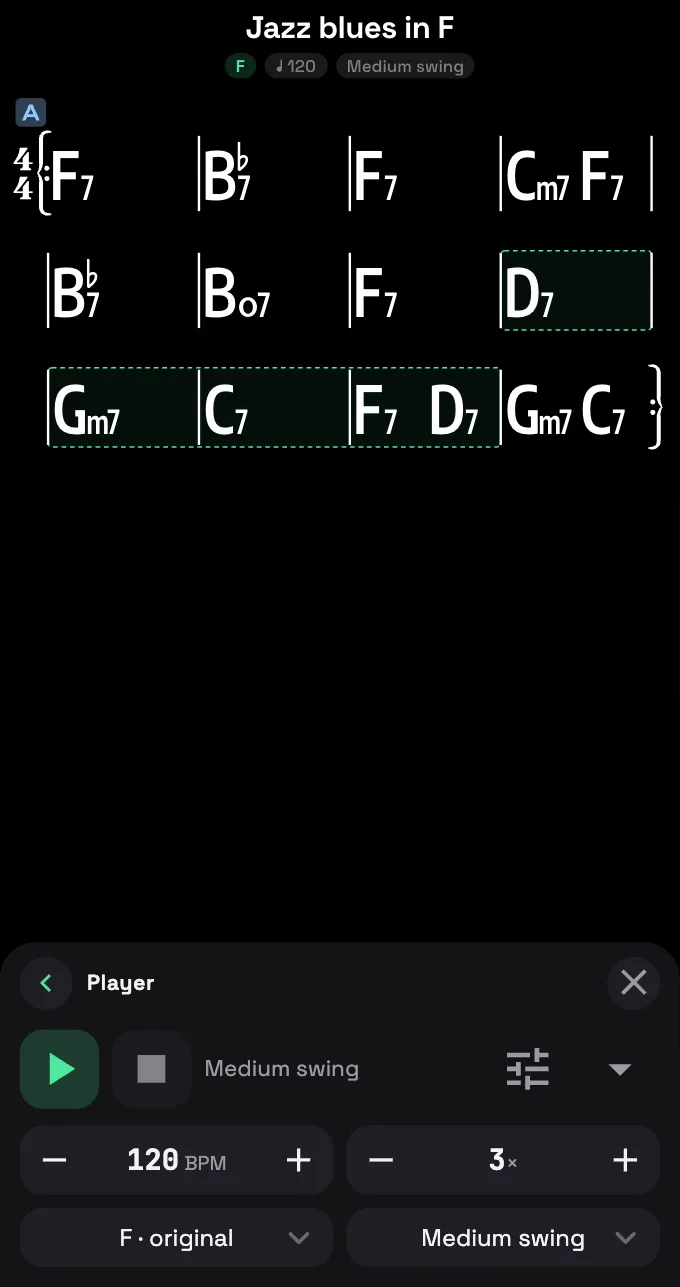
A loop that goes round twenty times does more for those bars than twenty choruses, where they come up once each.
Which instruments should I turn off?
Your own, to begin with. A pianist working on comping wants bass and drums without the piano; a bassist wants the bass gone so their line is the only one; a horn player can keep the whole band. Then try the harder setups:
- Drums only. No harmony under you. If your line makes the changes heard on its own, it works.
- Bass and drums, no chords. For a soloist, more room and less to hide behind.
- No drums. You keep the time. Any rushing shows at once against the bass.
In Gigplay, the Player plays any chart you have with piano or guitar, bass and drums. Under More options, each instrument can be turned off, Loop plays the bars you choose over and over, and Speed up raises the tempo each time through. See The band.
How do I know it's working?
Record yourself and listen for three things:
- Did you lose the form? If you can't say which bar you were in at any moment, work on that before anything else.
- Did your line change when the chords did? Listen at bars 5, 9 and 11–12 of the blues, wherever the harmony moves.
- Were you in time with the band, or near it? If you rush into the downbeats, try a lower tempo for that task.
Then change one thing and go again: another key (practicing in all 12 keys), another tempo, another tune. Same backing track, new task.