A capo raises everything you play by a half step (semitone) for each fret. So the chord you hear is the shape you finger, moved up by the number of the fret: a G shape with the capo at fret 3 sounds B♭, a C shape at fret 5 sounds F. The chart below gives every common open shape at every useful fret, and the second table works the other way: give it the key, it gives you the capo position and the shapes.
What does each chord shape sound like with a capo?
Read across from the fret to the shape you are fingering. The minor shapes have columns of their own, because the usual names are not always the major column plus "m": at capo 4 an Am shape is C♯m, not D♭m.
| Capo fret | C | A | G | E | D | Am | Em | Dm |
|---|---|---|---|---|---|---|---|---|
| none | C | A | G | E | D | Am | Em | Dm |
| 1 | D♭ | B♭ | A♭ | F | E♭ | B♭m | Fm | E♭m |
| 2 | D | B | A | F♯ | E | Bm | F♯m | Em |
| 3 | E♭ | C | B♭ | G | F | Cm | Gm | Fm |
| 4 | E | D♭ | B | A♭ | F♯ | C♯m | G♯m | F♯m |
| 5 | F | D | C | A | G | Dm | Am | Gm |
| 6 | G♭ | E♭ | D♭ | B♭ | A♭ | E♭m | B♭m | G♯m |
| 7 | G | E | D | B | A | Em | Bm | Am |
| 8 | A♭ | F | E♭ | C | B♭ | Fm | Cm | B♭m |
| 9 | A | F♯ | E | C♯ | B | F♯m | C♯m | Bm |
| 10 | B♭ | G | F | D | C | Gm | Dm | Cm |
So with the capo at 2, the shapes G, Em, C and D sound A, F♯m, D and E. Seventh chords and other shapes follow their root: a capo-3 E7 shape is G7, a capo-3 Am7 shape is Cm7.
The names in the table are spelled the way the key is usually written (D♭ rather than C♯, E♭ rather than D♯; C♯m and G♯m rather than D♭m and A♭m). If the song's chart uses the other spelling, it is the same sound; Key signatures and enharmonic spelling explains which to choose.
Which capo position should you use for a given key?
The open major shapes come in five families: C, A, G, E and D. Here are the ways to reach the keys that are awkward in open position:
| Key you need | Capo and shapes |
|---|---|
| F | capo 1, E shapes; capo 3, D shapes; capo 5, C shapes |
| B♭ | capo 1, A shapes; capo 3, G shapes; capo 6, E shapes |
| E♭ | capo 1, D shapes; capo 3, C shapes; capo 6, A shapes |
| A♭ | capo 1, G shapes; capo 4, E shapes; capo 6, D shapes |
| D♭ | capo 1, C shapes; capo 4, A shapes; capo 6, G shapes |
| B | capo 2, A shapes; capo 4, G shapes; capo 7, E shapes |
| F♯ | capo 2, E shapes; capo 4, D shapes; capo 6, C shapes |
| Bm | capo 2, Am shapes; capo 7, Em shapes |
| Fm | capo 1, Em shapes; capo 3, Dm shapes; capo 8, Am shapes |
Minor keys pick their minor shapes the same way. For a song in Cm, an Am shape at fret 3 is the home chord; the rest of the song's chords come from the A minor family (Dm, Em, F, G shapes).
How do you work out the capo for any key?
Count the half steps from the shape key up to the key you need. That number is the fret.
- Write the song's key and the shapes you would like to play in.
- Count up from the shape key to the song's key: from G up to B♭ is G♯, A, A♯/B♭, three half steps.
- Put the capo at fret 3, and transpose every chord of the song down three half steps to find its shape: B♭ is a G shape, Cm an Am shape, E♭ a C shape, F a D shape.
For step 3 you are transposing chords, the usual way; How to transpose chords into any key has the full method and the table of intervals.
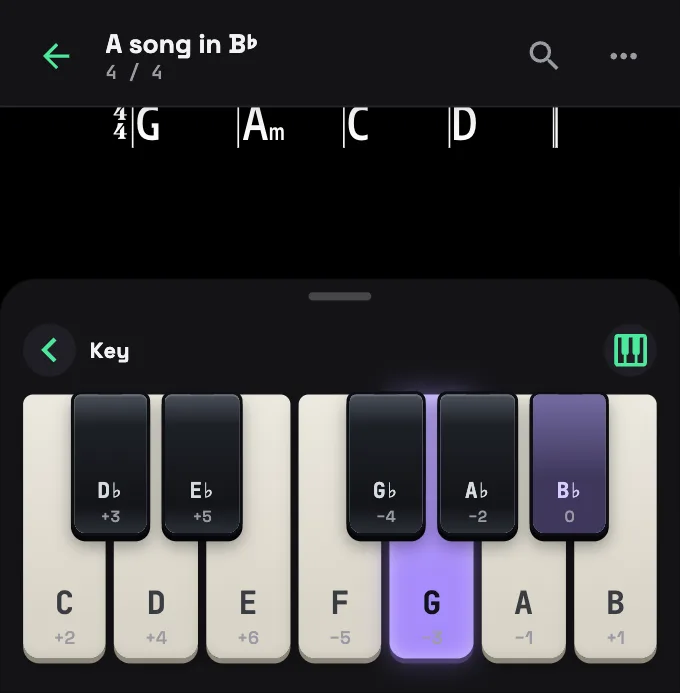
In Gigplay, the Key page shows each key's distance from the song's own in half steps. For a song in B♭, the key of G is marked -3: capo 3, G shapes. Pick it in a playlist of your own and you read the shapes there, while the playlist you share with the band keeps the song in B♭. The Player follows the key set for each playlist, so practice along with it in the B♭ one (see Changing key).
Why use a capo instead of barre chords?
- The open-string sound. Open shapes ring; a song in E♭ played with C shapes at fret 3 keeps the drones and open strings that a barre version loses.
- The voicings you know. Familiar riffs and fills built around open G or D shapes still work, just higher.
- The singer. Moving a song to the right key for the voice can land it in E♭ or A♭, keys with no easy open chords; a capo makes that a ten-second change.
- Two guitars. For a song in G, one guitarist plays open G shapes and the other uses capo 5 with D shapes, or capo 7 with C shapes. Same chords, different voicings, and the two parts stop getting in each other's way.
Above fret 7 the frets get tight and the sound turns bright and small. That can be the point (a high, chiming part), but for a whole song it is usually better to choose a lower position.
What should the chart say when a guitarist uses a capo?
Write the chart in the chords that sound, for everyone. The bass player, the keys player and the horns need B♭, not "G shapes". Then add the guitarist's note at the top, "Capo 3 (G shapes)", and, if it helps, the shapes small or in brackets beside the real chords. A capo chart handed to a bassist as if it were the real one is the fastest way to a rehearsal in two keys at once.
For songbooks of lyrics with chords, the same rule applies: chords as they sound over the words, capo and shapes as a note. How to write chords over lyrics covers that layout, and Accompanying a singer the conversation about keys that usually comes first.
Common questions
Does a capo change the key of the song? Yes. The song sounds in the new key; the shapes only look like the old one. With capo 2 and G shapes, you are playing in A, and the band must too.
What about tuning down a half step? It works like a capo in reverse: every shape sounds a half step lower. With the guitar tuned down a half step, an E shape is E♭. Capo 1 on a down-tuned guitar brings you back to standard pitch.
Do the minor and seventh shapes work the same way? Yes: every shape moves by the same number of half steps, whatever its quality.