The Nashville number system writes each chord as a number: its place in the song's key. In the key of G, G is 1, C is 4, D is 5 and Em is 6m. The chart never names the key's letters, so the same chart works in any key: the bandleader calls "in A" and everyone plays A, D and E for 1, 4 and 5 without rewriting a thing. It was developed in Nashville's studios, for vocal groups and rhythm sections, and has spread to musicians well beyond them.
How do the numbers work?
Number the notes of the major scale 1 to 7. A chord built on each note gets that note's number.
| Number | Plain chord | In C | In G | In D | In E♭ |
|---|---|---|---|---|---|
| 1 | major | C | G | D | E♭ |
| 2m | minor | Dm | Am | Em | Fm |
| 3m | minor | Em | Bm | F♯m | Gm |
| 4 | major | F | C | G | A♭ |
| 5 | major | G | D | A | B♭ |
| 6m | minor | Am | Em | Bm | Cm |
| 7° | diminished | B° | F♯° | C♯° | D° |
A bare number always means a major chord. That matters: 2 is D major in the key of C, not Dm. The chart says exactly what is played, and a major 2 (a secondary dominant on its way to 5) is a different chord from a 2m.
How do you write minors, sevenths and other chords?
The number carries the root; everything else is written after it, the way chord symbols are. The usual marks:
| Written | Means | In the key of C |
|---|---|---|
| 6- or 6m | minor (this site writes m) | Am |
| 5⁷ | dominant seventh (the 7 small and raised) | G7 |
| 1maj7 | major seventh (or a small triangle) | Cmaj7 |
| 2m7 | minor seventh | Dm7 |
| 4sus or 5sus | suspended 4th | Fsus4, Gsus4 |
| 1/3 | 1 chord, its 3rd in the bass | C/E |
| 4/5 | 4 chord over the 5th in the bass | F/G |
| ♭7 | major chord on the flattened 7th | B♭ |
| ♭3, ♭6 | major chords borrowed from the minor key | E♭, A♭ |
| 7° | diminished | B° |
Slash chords work in numbers too: 1/3 is "one over three", a C chord with E in the bass, and 4/5 is the sound of an F chord over a G bass that can take the place of a plain 5. What is a slash chord? covers how to voice them.
How are bars and rhythm shown?
Each number is one bar (measure) unless the chart says otherwise. In 4/4, "1 4 1 5" is four bars: one of 1, one of 4, one of 1, one of 5. Everything else is marked on top of that:
- Split bars: two or more chords in one bar are underlined together; an underline can't always be typed, so this page uses parentheses. (1 4) is two beats of 1 and two of 4. For uneven splits, tick marks over the numbers count the beats, one tick a beat.
- Diamonds: a number in a diamond is played once and left to ring for the bar (a whole note in 4/4).
- Pushes: an arrow by the number (typed here as
<4): the chord comes early, anticipating the beat. More in pushes, kicks and hits. - Chokes: a marcato accent (^) or a staccato dot over the number: hit it and stop dead. A fermata holds; "stop" or "band out" in words for longer breaks.
- Sections: the name, or an abbreviation the band agrees on, at the start of each (Intro, Verse, Chorus, Bridge, Tag), with "x2" for a repeat.
Time signatures are written at the start where they are not 4/4, and a bar of 2/4 in the middle of a 4/4 song gets its own small mark.
What does a full Nashville chart look like?
Here is a song written for this page, in 4/4, as a bassist would see it, then read in two keys. Each cell is a bar; (6m 5) is a split bar, two beats each.
| Section | Bar 1 | Bar 2 | Bar 3 | Bar 4 |
|---|---|---|---|---|
| Intro | 1 | 4 | 1 | 5 |
| Verse | 1 | 1/3 | 4 | 1 |
| Verse | 6m | 4 | 5sus | 5 |
| Chorus | 4 | 5 | 6m | 1/3 |
| Chorus | 4 | 5 | 1 | 1 |
| Tag | 4 | 5 | (6m 5) | 1 (diamond) |
In G, the first verse line is G, G/B, C, G and the chorus starts C, D, Em, G/B. In E, the same lines are E, E/G♯, A, E and A, B, C♯m, E/G♯. Nobody needed a new chart.
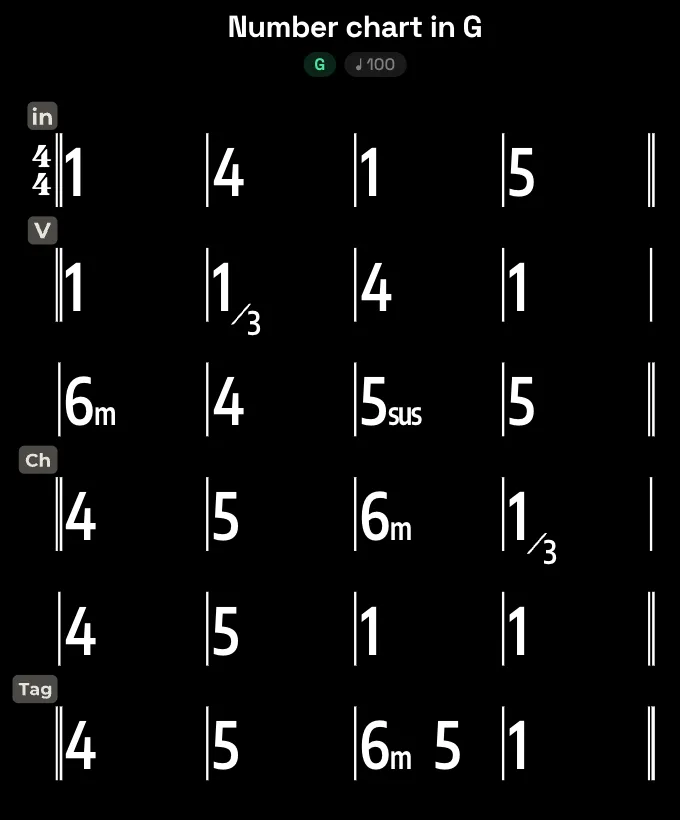
Typed the way a player would scribble it, with dashes for minor and a push into the chorus's second bar, the chorus looks like this:
KEY: G   4/4
CHORUS   4    <5    6-    1/3
         4     5    1     1
How are minor keys written?
There are two habits, and a band must agree on one.
| Chord in A minor | Counted from the relative major (C) | Counted from the minor tonic |
|---|---|---|
| Am | 6m | 1m |
| Dm | 2m | 4m |
| E7 | 3⁷ | 5⁷ |
| F | 4 | ♭6 |
| G | 5 | ♭7 |
| C | 1 | ♭3 |
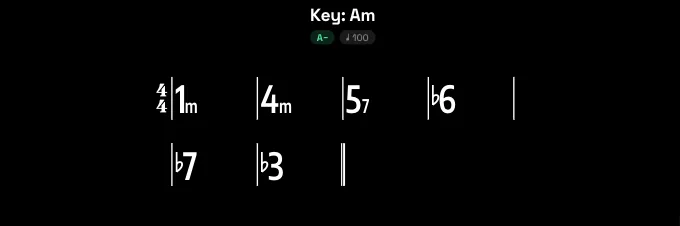
The usual Nashville habit is to count from the relative major: a song in A minor is charted as if in C, its home chord is 6m, and every number stays free of flats. It also works well for songs that move between the minor key and its relative major. Counting from the minor tonic keeps the home chord on 1, so "1m 4m 5⁷" reads like the minor song it is, and matches Roman numerals. Gigplay counts from the minor tonic, so a chart in Am shows 1m 4m 5⁷. Whichever you use, write the key at the top ("Key: Am") so nobody has to guess.
How do key changes and chromatic chords fit in?
- Chords outside the key take a flat or sharp before the number: ♭7, ♭6, ♯4°. A major 3 or 6 (E or A in C) is usually a secondary dominant, written plainly as 3 or 6, or 3⁷ and 6⁷.
- A key change is written where it happens, with the new key ("Key: A" or "up a step"), and the numbers count from the new 1 after it. A last chorus a whole step up is still "4 5 6m 1/3" on the page.
Who invented the Nashville number system?
Neal Matthews Jr., of the vocal group the Jordanaires, developed it in the late 1950s, to write the group's vocal parts in numbers. In the early 1960s the harmonica player Charlie McCoy adapted it to chart chords for the rhythm section: bass, drums, piano and guitar. From Nashville's studios it spread to musicians everywhere.
Why do musicians use the Nashville number system?
- Any key, at once. A singer can ask for the song a step down five minutes before the set and nothing is rewritten. If your band backs different singers, or plans worship sets around whoever leads that week, one chart serves every key.
- You hear the song, not the letters. After a while, "1 6m 4 5" is a sound, and the same sound turns up in song after song, which makes learning by ear faster.
- Charts are fast to write. A whole song in a minute, in pencil, at the session.
It has limits. The numbers say little about voicings, the melody or complex jazz harmony, where Roman numerals or a lead sheet carry more. Roman numerals vs Nashville numbers compares the two.
Gigplay can show any chart as Nashville numbers: open the song's menu, tap Chords as and choose Nashville. The numbers count from the song's key, so they stay the same when you change key (see Reading a song).
To write your own, step by step, from blank page to session-ready chart, see How to write a Nashville number chart.