

Write each chord directly above the syllable that is sung when the chord changes, which is usually the stressed syllable on the first beat of the bar (measure), or on beat 3 when a bar has two chords, and not necessarily the start of the word. In plain text, use a fixed-width font such as Courier and spaces (never tabs) so the chords stay over their syllables; better still, write the song in ChordPro, where each chord sits in brackets inside the lyric line, just before its syllable, and can never drift. The rest of this page covers the cases that trip people up: pickups, changes on a held note, bars where nobody sings, and transposing.
Where exactly does the chord go?
Over the syllable the singer is on when the band changes chord. Here is a verse written for this article, in G, one chord to a bar; each column is one bar, the chord over the words sung in it:
| G | C | G | D |
|---|---|---|---|
| Rain on the | win-dow, | cof-fee gone | cold, |
Written as a lyric sheet in plain text, with the next line (which starts with a pickup, see below), it looks like this:
G           C       G           D
Rain on the window, coffee gone cold,
           G            Em    C  D
I left the light on for you,
So G goes over "Rain", C over "win", G over "cof", D over "cold". Each chord sits over the first letter of its syllable, or over its vowel; whichever you choose, be consistent. What matters is that a guitarist reading at speed changes chord on the right word.
The common mistake is putting the chord over the start of a word when it changes in the middle. If the chord changes on the second syllable of "a-gain", it goes over "gain", not over the "a".
What about words sung before the first chord?
That is a pickup: words that start before the downbeat. The chord goes over the syllable on beat 1, and the pickup words sit to its left with no chord over them:
| (pickup) | G | Em | C D |
|---|---|---|---|
| I left the | light on for | you, |
"I left the" is sung over whatever came before (the end of the intro, or the last chord of the previous line). A reader who sees G over "I" would change a beat or two early. Pickup bars explains how they are counted.
What if the chord changes when nobody is singing?
It happens on held notes, at the ends of lines and between phrases. Three ways to write it:
- On a held note: put the chord after the word, over the empty space where it changes. Some writers stretch the word with underscores (
cold______) and put the chord over the end of the line. - At the end of a line: write the chord after the last word, as in the "C D" bar above, where the singer has finished and the band plays two chords.
- Whole bars with no singing (an intro, a turnaround, a solo): give them their own line, written as bars:
| G | C | G | D |. A lyric sheet with no bars at all leaves the band guessing how long a gap lasts.
How do you show how long each chord lasts?
Chords over lyrics do not show rhythm. A singer who knows the song does not need it, but the bass player who has never heard it does. Fixes that work:
- Put a barline in the lyric line before each bar's first syllable, as in
| Rain on the | window, | coffee gone | cold, |. It adds little clutter and makes the bar count visible. - Write "2x" or "(4 bars)" beside instrumental lines.
- For anything with odd bar lengths, a stop, or hits, give the band a real chord chart and keep the lyric sheet for the singer. How to write a chord chart covers that, and chord chart vs lead sheet helps decide which a band needs.
How do you keep chords lined up in plain text?
Plain text with chords on their own lines breaks easily:
- Use a fixed-width font. In Courier or any "mono" font every letter is the same width, so a chord over the eleventh character stays over the eleventh character. In a proportional font, it lands somewhere else.
- Use spaces, not tabs. A tab is a different width in every program.
- Keep each chord line directly above its lyric line, with nothing between them.
- Paste carefully. An email program or a messaging app may switch to a proportional font or remove repeated spaces. Send a PDF, or ChordPro, instead.
- Leave space for long chord names. If Cmaj7 and D7sus4 fall on syllables close together, add spaces in the lyric line (or extend a word) so the chords do not run into each other.
Why ChordPro is easier
ChordPro writes the chord inside the line, in square brackets, before the syllable it falls on. The same two lines from above, with a title, a key and the verse marked:
{title: Rain on the Window}
{key: G}

{start_of_verse}
[G]Rain on the [C]window, [G]coffee gone [D]cold,
I left the [G]light on for [Em]you, [C] [D]
{end_of_verse}
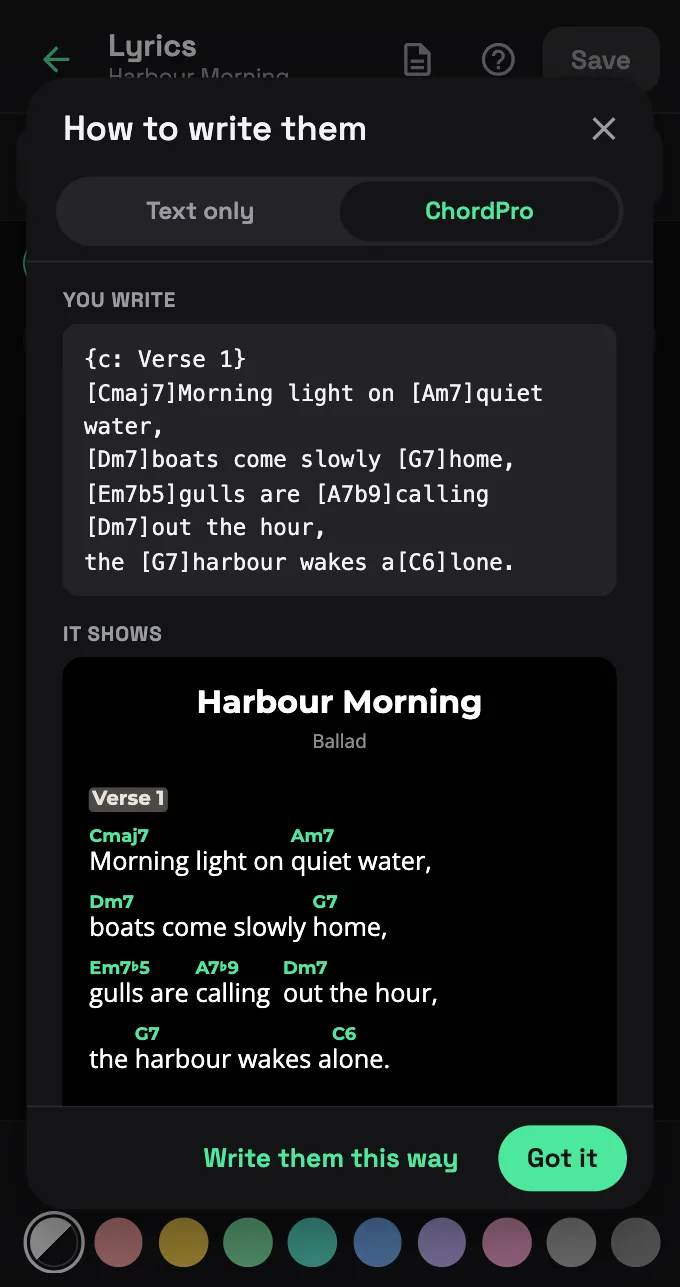
The chord is tied to its syllable, so it cannot drift whatever the font, the screen width or the key. A ChordPro reader draws the chords over the words for you. The ChordPro format covers the rest of the syntax: the directives in braces, sections and comments.
In Gigplay, the Lyrics tab of the editor takes lyrics in ChordPro, with a preview under the field showing the chords over the words. Those chords change key with the song, and Lyrics mode shows them as a songbook page (see Melody and lyrics). They are the lyric sheet's own chords, written beside the song's chart rather than taken from it. A ChordPro file you already have can be imported instead of retyped: the song comes in with its lyrics and their chords, and a chart made from those chords (Bringing in your songs).
What happens when you transpose?
In ChordPro, nothing goes wrong: each chord is renamed (how to transpose chords shows how the names change) and stays where it was. In plain text, chord names change length: G becomes A♭ (up a half step), Em becomes F♯m (up a whole step), and a chord line that was lined up is now pushed one or two characters to the right. Every transposition means checking the alignment by eye. That alone is a good reason to keep a song in ChordPro and print or export it in whatever key the singer needs.
Should you write capo shapes or real chords?
Write what the reader plays. For a band, write the sounding chords (concert pitch), since the bass and keys play those. For a guitarist with a capo, a separate copy with the shapes and "Capo 3" at the top is easier to read than doing the sums on stage. Never mix the two on one sheet. The capo chart shows which shapes give which key.
A checklist for a lyric sheet with chords
- Title, key, and capo (if any) at the top.
- Section names (Verse 1, Chorus, Bridge) on their own lines.
- Every chord over the syllable where it changes, including pickups and held notes.
- Instrumental bars written as bars, with a count.
- The chorus written out in full the first time; after that, "Chorus" alone is enough if it is identical.
- A large font: singers read it from a stand or a screen at arm's length, often under bad light.