

To learn a lot of songs fast, don't learn them one by one from the top. Sort the list into songs you know, songs you nearly know and songs that are new; write each song as a one-line chart in numbers; learn the progressions and forms the songs share once; and spend your practice on what makes each song different: the intro, the hits, the ending, the odd chord. Thirty songs isn't thirty times the work of one, because songs share their parts.
First: what does "learn" mean for this gig?
Before you practice anything, find out what the gig actually asks for. Ask the bandleader:
- Can you read on stage? Charts on a stand or a tablet change the job completely: reading a clear chart is one skill, memorizing 30 songs in a week a different and much bigger one.
- What keys? The singer's keys, which may not be the record's. Get them in writing.
- Whose version? The record's arrangement, or the band's own? If the band has rehearsal or live recordings, those beat the originals.
- The order. If there's a setlist, learn in that order and listen in that order.
- Starts and endings. Who counts in, who plays the intro, how each song ends.
The answers can halve the work. A function band that reads from charts and plays every song "as the record, but in the singer's key" needs a very different week from a band that plays from memory with its own endings.
How do I sort 30 songs?
Go through the list once, quickly, and put every song in one of four groups:
| Group | What it means | Time it gets |
|---|---|---|
| Know it | Played it recently, in this key | One listen-through, in set order |
| Nearly | Know it, but in another key or arrangement | A listen and a chart check |
| New, simple | New, but built on a familiar progression and form | A chart and a couple of run-throughs |
| New, hard | Odd form, lots of hits, a key change, a long intro | Most of your time |
Don't spread your time evenly. The songs in the last group are where gigs go wrong; the first group needs almost nothing.
Chart every song on one line
Write each song as a short chart in Nashville numbers, so it works in whatever key the singer calls. For a song written for this article, in G at 96 BPM:
| Section | Numbers | Note |
|---|---|---|
| Intro | 1 5 6m 4 | Guitar alone |
| Verse | 1 5 6m 4, ×2 | |
| Pre-chorus | 4 5 4 5^ | The ^ over the last 5: hit it and cut it off |
| Chorus | 1 5 6m 4, ×2 | |
| Bridge | 6m 4 1 5, ×2, then 4 | Hold the 4 for two bars (measures) |
| Out | Chorus ×2, end on 1 |
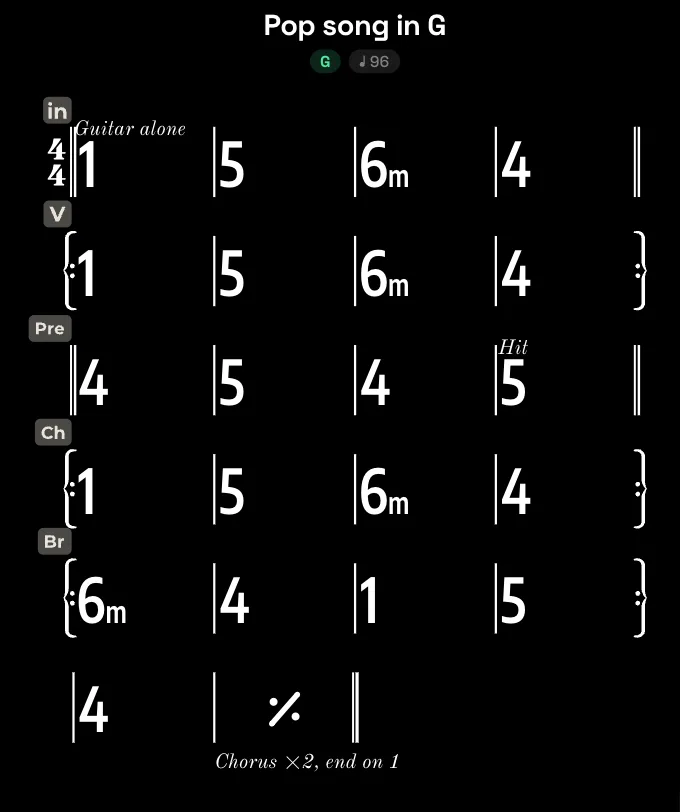
That's a whole song you can play on a page you can read in ten seconds. The Nashville number chart article covers the notation. If there's no chart and you have to work the song out from the recording, figuring out chords by ear gives a fast method.
Learn the shared progressions once
Once your songs are in numbers, the same lines turn up again and again. A few of them:
| Progression | In G | What it is |
|---|---|---|
| 1 5 6m 4 | G D Em C | The I–V–vi–IV |
| 1 6m 4 5 | G Em C D | The I–vi–IV–V, the "'50s progression" |
| 6m 4 1 5 | Em C G D | The I–V–vi–IV loop started on the minor |
| 1 4 5 | G C D | The three chords of the key, I, IV and V |
| 1 ♭7 4 1 | G F C G | A ♭VII borrowed from the minor: a Mixolydian colour |
| 1 4 5 over 12 bars (the 12-bar blues) | G7 C7 D7 | The blues form |
Group the songs that share a progression and practice them together. Within a group, only the order and length of the sections differ, and that's what your one-line chart holds. Common chord progressions covers these in more detail, and how to memorize chord changes shows how to make them stick.
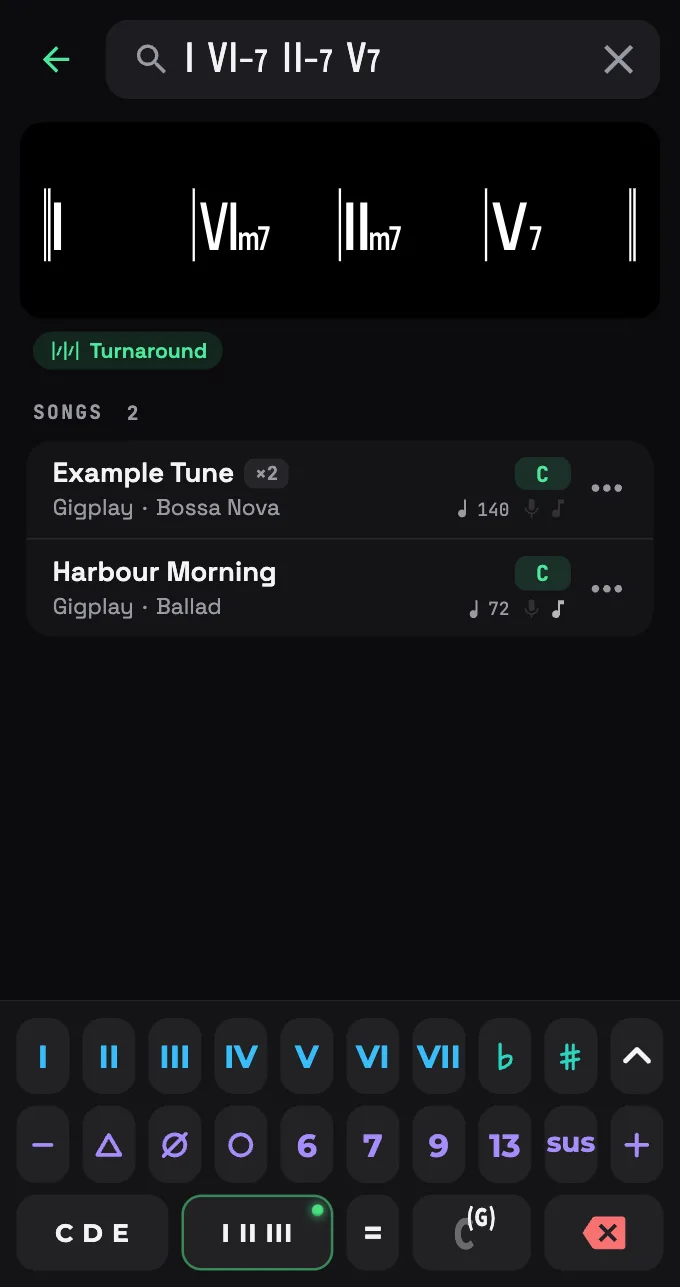
In Gigplay, Search a progression in Smart lists finds every song in your library that uses a progression, in any key: type it as degrees (I V VIm IV) or as chords (G D Em C) and see which songs share it (Playlists and your library).
Spend the time on what's different
A song in a set is rarely hard all the way through. They're easy for three minutes and hard for ten seconds. Find the ten seconds and loop that part of the recording, slowed down if your player allows it, until you can play along at full speed:
- the intro, especially a riff or a pickup into the first bar;
- hits, stops and pushes;
- a key change, or a bar of 2/4 that breaks the pattern;
- a chord that's not in the key;
- the ending.
Five minutes on a song's two hard bars beats three run-throughs of the whole song.
Should I learn one song at a time?
No. Finish song 1 on Monday and song 30 on Saturday, and by Saturday song 1 has faded. Rotate through the whole list every day instead: a little of every song, every day, with the extra minutes going to the hard ones. Start at a different place in the list each day, so the songs at the end don't always get you at your most tired.
A week to the gig: a plan
| Day | The whole list | The day's focus |
|---|---|---|
| 1 | One listen, in set order | Get the list, the keys and the recordings. Sort the songs. Make a playlist in set order. |
| 2 | One listen, chart in hand | Chart every song not in the "know it" group, one line each, in numbers. |
| 3 | A little of every song | The shared progressions in the gig keys. Play along with the "nearly" songs. |
| 4 | A little of every song | The "new, hard" songs: hard bars, intros, endings. |
| 5 | Every song once, with the recordings | Mark what broke. |
| 6 | The whole set in order, without stopping | Fix what broke first. |
| Gig day | Starts and endings only | Rest. |
On every day, listen to the set in order while you travel or cook. Listening with the chart in front of you is real work: you're checking the form against the sound.
Can I just read charts on the gig?
If the bandleader agrees, yes, and for 30 new songs in a week it's the sensible way. Use the week to learn the songs well enough that the chart is a reminder, not something you read note by note: you should know where the song goes, and glance down for the details. Depping on a gig has more on preparing as a sub.
If some songs must be played from memory, choose them early and give them the extra days. How to memorize songs for a gig has the method.
Keep the charts and the keys together. In Gigplay, a song's key is remembered per playlist (Changing key), so this gig's playlist can have a song in the singer's key while your own copy stays as written.