

A good setlist opens with a song the band could play half asleep, ends on the strongest song you have, and in between moves the energy up and down on purpose, so that no two songs side by side share the same tempo, key and feel. Build it in four passes.
How do you make a setlist, step by step?
- Choose the opener and the closer. A sure song to start, your strongest to finish.
- Shape the middle in waves. Three to five songs building up, a breather, then build again.
- Check the neighbours. No two songs side by side with the same key, tempo and feel; tunings and capo changes grouped together.
- Time it and add spares. Add up the songs and the gaps, trim to the length of the set, and write two spares under the last song.
The sections below take each pass in turn.
What makes a setlist good?
Three things, in this order.
- It suits the room. A dance floor at a wedding (wedding and function band setlists plan that night in full), a bar where people are talking, and a seated concert want different sets from the same band. Decide what the night is for before you pick a single song.
- It keeps the energy moving. An audience notices four mid-tempo songs in a row long before it notices a wrong chord.
- It is easy to play. Few instrument changes, retunings and capo moves; no singer doing three belters back to back; nothing brand new at the very top.
A band playing its own songs follows the same rules, with one more: open with your best-known song, not your newest. Put the new single, or the song you most want people to remember, in the last third of the set, when the room is listening. And play no more than one or two unreleased songs in a row: an audience will follow you into new material, but not for half an hour.
How do you choose the opening song?
The first song is the one the audience hears while the sound engineer is still fixing the mix and the band is still nervous. Choose:
- a song everybody in the band knows cold, ideally one you have played at many gigs;
- a medium-up tempo, not your fastest: nerves push fast songs faster;
- a clear start, such as a drum count or a guitar riff, rather than a free-time piano intro or a singer coming in alone;
- not the song with the hardest vocal. Let the singer warm up.
Play the first two songs back to back, with no talking in between, and the set has momentum before anyone picks up a microphone.
Which song should close the set?
Your strongest: the song that gets the biggest reaction, the one people sing along to or dance to. If there are several sets, end each of them on something strong too, so that people stay for the next one. Keep one more good song back for an encore rather than spending everything on the last number.
If the set has to stop early (a late start, a hard curfew), cut songs from the middle, never the closer. Know before you go on which two songs you would drop.
At a function, ask whether the client wants a particular last song. Otherwise it is yours to choose, and it is what people remember on the way out.
How do you order the songs in the middle?
Think in waves of three to five songs: build up, reach a peak, come down for a breather (a ballad, a feature for a soloist, a quieter acoustic number), then build again to a higher peak. A set that only goes up tires everyone out; a set that wanders has no shape.
Here is a 45-minute covers set of 11 songs laid out that way. The songs are described by their role, but the keys, tempos and feels are what you would actually check.
| # | Role | Key | Tempo | Feel | Why it's here |
|---|---|---|---|---|---|
| 1 | Opener | A | 124 | Rock, straight eighths | Known cold, starts on a drum count |
| 2 | Straight in, no talking | D | 138 | Pop | Keeps the momentum, a fresh key |
| 3 | Singalong | G | 100 | Half-time groove | Brings the room in |
| 4 | First peak | E | 144 | Shuffle | Faster, and a swung feel for contrast |
| 5 | Breather | C | 66 | Ballad in 6/8 | The first slow song, in a low part of the voice |
| 6 | Building again | E minor | 104 | Funk, sixteenths | A minor key after a run of major ones |
| 7 | The new song | F | 116 | Pop | Mid-set, once the band has settled |
| 8 | Guitar feature | A minor | 96 | Heavy half-time rock | A long solo rests the singer |
| 9 | Up | B♭ | 126 | Four on the floor | The climb to the end starts |
| 10 | Biggest singalong | G | 108 | Pop | The room is warm: give it the song it wants |
| 11 | Closer | E | 150 | Rock | Your strongest song, ending on a big hit |
| — | Spare | A | 128 | Rock | If time is left, or the room wants more |
| — | Spare | C | 76 | Ballad | If the room needs calming down |
Should songs next to each other be in different keys?
Usually, yes. Two songs in the same key at a similar tempo blur into one, even for listeners who could not name a key. A change of key freshens the ear, especially a move up: a step or a half step up sounds like a lift, and a move by a fourth or a fifth sounds natural.
Staying in the same key is useful on purpose: for a medley, or when one song runs straight into the next. Segues between songs in different keys explains what to play when the keys don't match.
If your list runs through E, A, D and G all evening, break the run with a song in C, F or B♭ now and then. And look at the songs from the singer's side: three songs in a row near the top of their range will tire any voice, however good the key is for each song on its own. If a song sits badly, change its key rather than its place in the set.
How do you handle tempo, feel and changes on stage?
The same idea as keys: change the tempo or the feel from one song to the next, and when the feel stays the same, move the tempo by 10 to 20 BPM or more. Alternate straight eighths with swung or shuffled ones, 4/4 with 3/4 or 6/8. Write each song's tempo on the setlist, so the count-in is the song's tempo and not the speed of your nerves.
Then group the practical changes:
- songs in an alternate tuning (drop D, a half step down) together, so the guitarist retunes once;
- capo songs together, in the order of the capo positions;
- instrument swaps (keys to accordion, bass guitar to double bass) at the start of a set or next to a talking break;
- the acoustic songs together, as a section of their own.
How long should a set be, and how many songs?
Time it. If your songs run 3¾ minutes and the gap between them is half a minute, each takes 4¼ minutes, and a 45-minute set holds 10 or 11 (45 ÷ 4¼ ≈ 10.6). A jazz set, with solos, holds far fewer. How many songs in a set has the sums for each length of set and each style.
Always add two spares under the last song: one up, one down. If you finish early, or the room asks for more, you are not choosing in front of the audience.
What should the setlist itself show?
At least each song's title, key and tempo, in large print. Add who starts, the feel, and any segue or capo, as a short note, if the band needs them. A setlist template shows a layout that works on a dark stage.
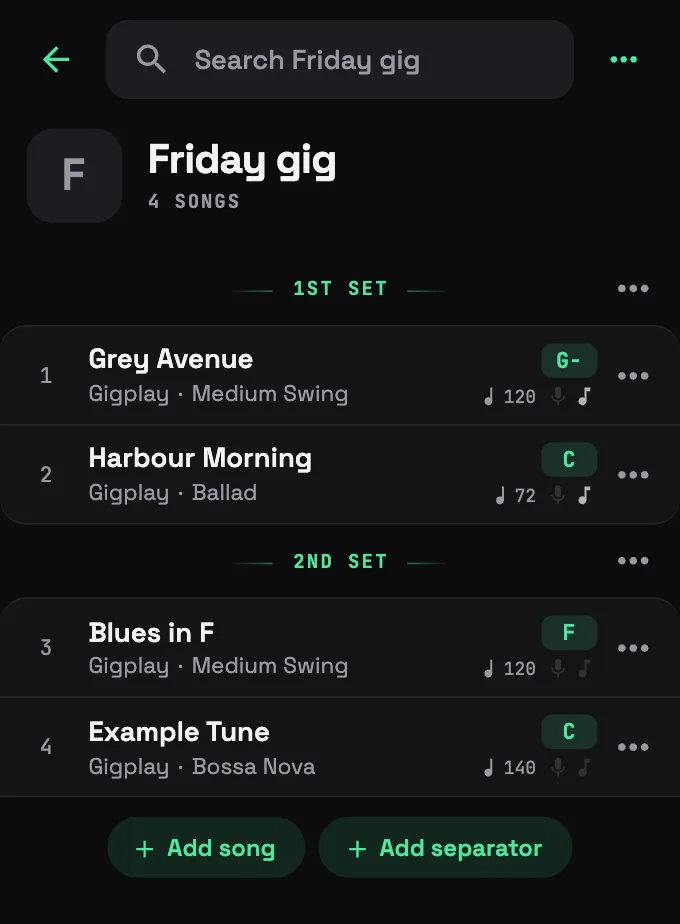
In Gigplay, a setlist is a playlist: tap the songs in the order you want them, hold and drag to move one, and add a separator such as "2nd set" between the sets. The key, tempo and style you set for a song are kept in that playlist only, so your singer's set can have a song in F while your practice list keeps it as written. On stage, swipe left for the next song and right for the one before: the playlist is the running order (Playlists and your library).
How do you test the set before the gig?
Play it in order, once, at the last rehearsal, starting and stopping each song as you would on stage: count-ins, endings, the gaps, the talking. That is where you find the two songs that start with the same riff, the retune that takes too long, and the segue nobody had agreed on. Running a rehearsal has a plan for that evening.
On the night, the setlist is a plan, not a contract. If the room is dancing, skip the ballad; if it is a quiet room, bring a spare in early. A list with clear waves and spares makes those calls easy.