Slash notation writes rhythm without pitch. A slash on the staff takes the place of a note head: you play the chord written above it, in your own voicing, and the slashes tell you about the rhythm. Plain slashes, one per beat, mean "play time on this chord in the style of the tune". Slashes with stems and beams (rhythmic notation) mean "play exactly this rhythm". On text charts, slashes also act as placeholders that show on which beat a chord changes.
What kinds of slash notation are there?
| What you see | Name | What you play |
|---|---|---|
| Four slashes in a bar (measure) of 4/4, no stems | Beat slashes, time slashes | Comp or groove in the style, on the chord above |
| Slashes with stems, flags, beams, ties, rests | Rhythmic notation, rhythm slashes | That exact rhythm, on the chord above |
| A hollow slash with a stem | A half note (minim) in rhythmic notation | Two beats, held |
| A hollow slash or diamond with no stem | A whole note (semibreve) in rhythmic notation | The whole bar of 4/4, held |
| "C7 / F7 /" typed in a bar | Slashes as beat placeholders | C7 for two beats, F7 for two |
| C/E | A slash chord, not slash notation | C major with E in the bass |
The last row trips people up. A slash between a chord and a note is a slash chord: it names the bass note. It has nothing to do with rhythm.
What do plain beat slashes mean?
Beat slashes say: "the harmony is here, the rhythm is up to you". You play the chord above them for as many beats as there are slashes, in whatever way suits the style and the band. A guitarist strums or comps, a pianist comps, a bassist walks or plays the style's pattern, a drummer plays time. Four bars of beat slashes, with the chords written above them:
  Dm7       G7        Cmaj7     A7
| / / / / | / / / / | / / / / | / / / / |
On a swing chart, a pianist might comp two short chords per bar on off-beats; on a bossa chart, a guitarist plays the bossa pattern; on a rock chart, eighth notes. The slashes are the same in all three. What changes is the style marking at the top, which is why it matters so much. Comping from a chord chart goes into what to play.
What does rhythmic notation mean?
When the slashes have stems, flags or beams, the rhythm is fixed: everyone reading it plays those attacks, and the chord changes exactly where the symbols are placed. You still choose the voicing.
Here is one bar written for this article, in 4/4:
| Beat | 1 | 1 and | 2 | 2 and | 3 | 3 and | 4 | 4 and |
|---|---|---|---|---|---|---|---|---|
| Slash | quarter | eighth | eighth | quarter rest | eighth rest | eighth, tied over | ||
| Chord | B♭7 | B♭7 | B♭7 | E♭7 |
Read: a B♭7 on 1, two quick B♭7s on 2 and the "and" of 2, a rest for beat 3 and the first half of beat 4, and an E♭7 on the "and" of 4 tied into the next bar. That last one is a push: the next bar's chord arrives an eighth (quaver) early. Accents, staccato dots and the short "hat" accent over the slashes tell you the length and weight of each attack. All of that is the language of pushes, kicks and hits.
Who plays rhythmic notation depends on where it is written. In the piano or guitar part, it is for that player. Written above the staff in a drum part, it shows the band's hits for the drummer to catch. Written in every part, it is a band figure, played together.
How do slashes place chords in a bar?
On a typed or handwritten chord chart, slashes are often used without a staff, as beat markers:
| Written | In 4/4 means |
|---|---|
| C7 | C7 for the whole bar |
| C7 F7 | Two beats each |
| C7 / F7 / | Two beats each, spelled out |
| C7 / / F7 | Three beats of C7, one of F7 |
| C7 F7 / / | One beat of C7, three of F7 |
| C7 / F7 G7 | Two beats of C7, then one each of F7 and G7 |
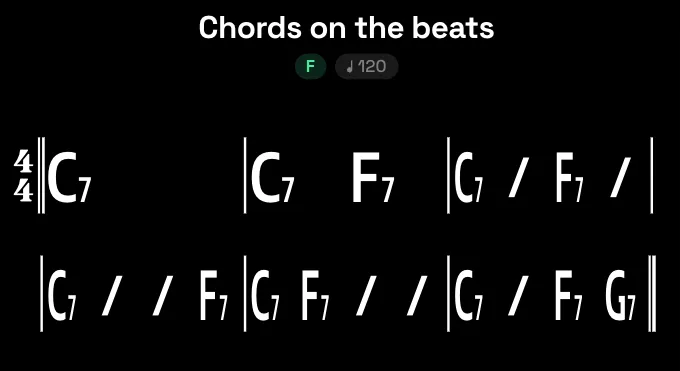
In 3/4, a bar has three positions: "Am / D7" means two beats of Am and one of D7. A single chord with nothing else fills the bar, whatever the time signature. How to read a chord chart covers the other ways a chart shows how long each chord lasts.
What do the other slashes on a chart mean?
- A slash between two dots in a bar (%): repeat the previous bar. That is the bar repeat sign, not a beat slash.
- Slashes through a note's stem: tremolo, or repeated notes. On a drum part, three slashes on a snare note mean a roll.
- A slash after a chord with a note name (D7/F♯): a slash chord, as above.
- A slash through a chord on some handwritten charts: a crossed-out chord. Ask.
How do drummers read slash notation?
Drum parts lean on slashes. Beat slashes mean time, in the style; rhythmic notation above the staff means hits to catch; a bar repeat sign with a count over it means more of the same groove. How to read a drum chart shows how they fit together on a whole part.
Why do writers use slash notation?
Because it says exactly what needs saying and nothing more. A written-out piano part ties the player to one voicing; a bar of slashes under Dm7 lets them play what fits the band and the room. It is also far quicker to write and to read. The skill it asks of you is to know your style: four slashes in a bossa nova and four slashes in a shuffle are two different grooves.
In Gigplay's chord editor, each bar is split into cells, and a chord on a later cell falls later in the bar: that is how a chart places chords on the beats (see Writing and editing a chart).
How do you practice reading rhythm slashes?
Take a short chart with rhythmic notation and clap the rhythm alone, counting "1 and 2 and" aloud. Then play it on one chord. Then add the changes. Pushes are the hard part: tie the "and" of 4 into the next bar in your count until it feels natural. With beat slashes, the practice is the other way round: play the same four bars of slashes in three styles, swing, bossa and straight eighths, and listen to how different they sound.