N.C. stands for "no chord". Written where a chord symbol would go, it tells the players who read chord symbols (guitar, piano, keys, and usually bass) to stop playing harmony until the next chord symbol appears. Something else fills the gap: the melody alone, a riff the band plays in unison, a drum fill, a vocal line on its own, or silence. N.C. is about the harmony only; it does not by itself tell everyone to stop.
Where do you see N.C. on a chart?
The same two letters turn up in a handful of everyday situations:
- A pickup before the first chord. On a lead sheet, the melody often starts a beat or two before the first bar (measure). The chord symbols start on the first full bar, and N.C. over the pickup makes it clear that no one should play a chord under it. See pickup bars.
- A riff in unison. An intro or a hook played by guitar, bass and keys on the same single notes, with no harmony under it. The chart writes N.C. over the riff's bars, with the riff in notation or tab.
- A break. The band stops for a bar or two while the singer, a soloist or the drummer carries on alone, then the band comes back on the next chord.
- Stop time. The band plays short hits (often on beat 1 of each bar) and is silent in between; N.C. marks the silence.
- An a cappella line. The singer alone, just before the last chord, say, or at the very start.
How is N.C. written?
You will see "N.C.", "NC", "n.c." and occasionally "No chord" or "(no chord)". All mean the same. Some writers draw it in brackets above the staff, some in place of a chord in the bar. In ChordPro files, N.C. goes in the brackets where a chord would go, right before the word it falls on, as in [N.C.]Lanterns on the [F7]harbour wall; the ChordPro format explains that syntax.
When you write a chart yourself, put N.C. exactly where the harmony stops, and put the next chord exactly where it comes back. Adding "break" or "drums continue" removes the drummer's question before it is asked. More on that in how to write a chord chart.
How long does N.C. last?
Until the next chord symbol. If a bar of N.C. is followed by a bar repeat sign (%), that bar is N.C. too. A chord symbol in the middle of an N.C. bar brings the harmony back on that beat.
The chord before an N.C. stops at the N.C., not before. If a bar reads "C7 N.C." in 4/4, play C7 for two beats and stop on beat 3. How short the stop should be (cut off cleanly, or let it ring) depends on the style and the rest of the band; when the chart doesn't say, a short cut-off, all together, is the safe choice.
What does each instrument do on N.C.?
| Instrument | On N.C. |
|---|---|
| Guitar, keys, piano reading chord symbols | Stop. Mute the strings or lift the hands, cleanly and in time. Play only a written riff or line, if there is one. |
| Bass | Usually stop. If a line is written (a unison riff, a fill), play it. |
| Drums | Depends on the chart. N.C. is about harmony: unless the chart says "break", "tacet" or shows rests, the drummer may keep time or play a fill. In stop time, play the hits with the band. |
| Singer, horns, melody | Carry on. In N.C. bars the melody may be heard on its own. |
When in doubt, ask the bandleader one question: "On the N.C. bars, does the drummer keep time?"
What does N.C. mean on guitar music and piano sheet music?
On guitar sheet music and in tabs, N.C. over a passage means do not strum chords there: play the single notes, the riff or the lead line written under it, or nothing. Chord boxes stop at the N.C. and start again at the next chord.
On piano-vocal-guitar sheet music, the chord symbols above the staff are for the guitarist (or anyone playing from symbols). N.C. there means the chord symbols stop, but a pianist reading the written notes plays whatever is written. On a piano chart with chord symbols only, N.C. means stop comping, as for guitar.
How is N.C. different from tacet, a rest, a break and stop time?
| On the chart | Means |
|---|---|
| N.C. | No harmony from the chord players until the next chord symbol. Others may play. |
| Rest | Silence for that player, for the length of the rest. |
| Tacet | This player does not play at all in this passage (often a whole section or chorus). |
| Break | The band stops for a bar or two, usually so a soloist or the drummer is heard alone. |
| Stop time | Short hits on given beats, silence between them, for several bars. |
On a chord chart, N.C. and a break often appear together: "break" over the bar for the drummer, N.C. in the bar for the harmony players. Tacet, tutti, fine and other chart words covers the rest of the vocabulary.
What does stop time look like on a chart?
Stop time is one place N.C. turns up on a band chart. Here are four bars in F written for this article, and the bar after: the band hits beat 1 of each bar, and the singer or soloist fills the rest.
| Bar | Chart shows | The band plays |
|---|---|---|
| 1 | F7 on beat 1 (accented), then N.C. | One short F7 on 1, then silence |
| 2 | B♭7 on beat 1, then N.C. | One short B♭7 on 1, then silence |
| 3 | F7 on beat 1, then N.C. | One short F7 on 1, then silence |
| 4 | C7 on beat 1, N.C., "fill" on beat 4 | Hit on 1, silence, drum fill into the next bar |
| 5 | F7 (time) | Everyone back in the groove |
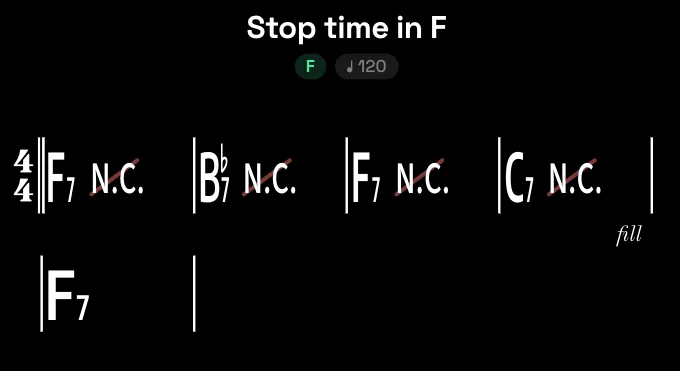
The trick to stop time is keeping the beat going in your head during the silence, so that the next hit lands with everyone. Counting quietly with your foot or your body is what holds it together. Hits and stops in general are covered in pushes, kicks and hits.
In Gigplay's chord editor, N.C. has its own key, No chord, beside the keys that repeat the previous bar or two (see Writing and editing a chart). When the band plays the chart, chords and bass stop on N.C. while the drums carry on.
Is N.C. the same as a fermata or a pause?
No. A fermata holds a note or chord longer than written, and the time stops with it. N.C. keeps the time going; only the harmony stops. A bar of N.C. lasts exactly a bar, and the next chord comes back in time. Reading a chart with N.C. bars is the same as reading any band chord chart: count the bars, look ahead, and come back in on the next symbol.